 Collingwood Handyman Services
Collingwood Handyman Services › Blog › Who Repairs Water-Damaged Walls and Flooring in Collingwood Homes?
← All articlesWho Repairs Water-Damaged Walls and Flooring in Collingwood Homes?
Key takeaways
- Use a restoration company for active leaks, standing water, sewage, mould risk, hidden moisture, or structural damage.
- Use a handyman for dry, stable, contained repairs to drywall, flooring, trim, paint, and other finishes.
- A flooring decision requires inspection of the visible surface, underlayment, subfloor, and adjacent structure.
- Sewage and mould work should be completed and documented by qualified restoration or remediation professionals before finish reconstruction.
- Collingwood’s emergency water and sewer permit notice applies to private water or sewer line repairs or replacements, not ordinary post-drying finish repairs.
- Stop work and arrange qualified asbestos assessment or abatement before disturbing suspect materials in older homes or cottages.
- Send photos, measurements, flooring details, drying records, and the property address when requesting a reconstruction quote.
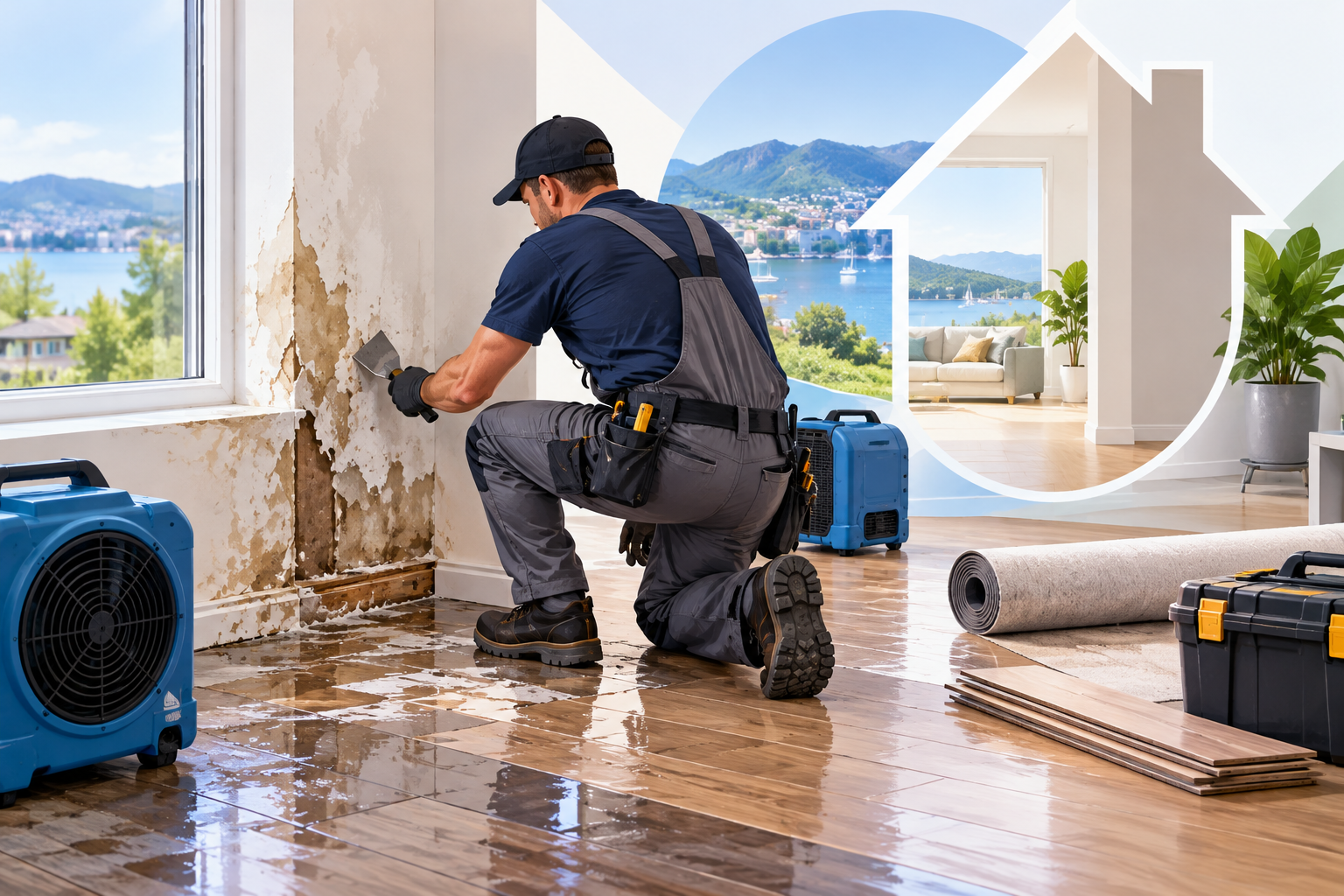
For wet, contaminated, or structurally affected damage, call a water-damage restoration company first; for dry, contained finish repairs, contact a qualified handyman or rebuild contractor. Collingwood Handyman is suited to the second stage, including contained drywall, flooring, trim, painting, and related finish work after the water source has been corrected and the area is ready for reconstruction.
Who repairs water-damaged walls and flooring in Collingwood homes?
A restoration company handles active water loss, extraction, contamination control, demolition, and structural drying, while a handyman or rebuild contractor repairs dry and stable walls, floors, trim, and paint.
The first call for a burst pipe, sewage backup, saturated ceiling, wet wall cavity, soft subfloor, or spreading moisture is a plumber, restoration company, or other qualified emergency specialist. The immediate work is to stop or contain the source, remove standing water, inspect affected assemblies, document conditions, and dry the building.
After mitigation, reconstruction can include:
- Replacing damaged drywall
- Repairing or replacing flooring
- Reinstalling baseboards, casing, and transitions
- Patching, priming, and painting walls or ceilings
- Replacing damaged insulation or finish materials
- Completing minor carpentry and tile repairs
The correct decision is simple: use restoration specialists for wet, contaminated, hidden, or unstable damage, and use a handyman for dry, defined, non-structural finish repairs.
Which professional should you call for each type of water damage?
Call the trade responsible for the active hazard or water source first, then schedule finish reconstruction after the area is dry, clean, documented, and safe.
| Condition | First professional to call | Typical work | Who handles the next stage? |
|---|---|---|---|
| Burst pipe or active plumbing leak | Licensed plumber and restoration company | Stop the leak, extract water, inspect and dry materials | Handyman, drywall contractor, flooring contractor, or rebuild contractor |
| Wet wall cavity, ceiling, or subfloor | Water-damage restoration company | Moisture assessment, selective removal, drying, and documentation | Finish-repair contractor after drying is complete |
| Sewage backup | Restoration and remediation company | Contamination control, removal, cleaning, drying, and remediation documentation | Handyman or rebuild contractor after written release for reconstruction |
| Suspected mould | Qualified mould-remediation professional | Source control, containment, removal, cleaning, and clearance documentation where required | Finish contractor after the affected area is cleared for rebuilding |
| Roof-related water entry | Qualified roofer and restoration company | Temporary protection, roof repair, extraction, and drying | Handyman or rebuild contractor for interior finishes |
| Dry water stain with no continuing moisture | Handyman or drywall professional | Remove compromised drywall, patch, seal, prime, and paint | The same finish contractor can complete the work |
| Swollen or failed flooring after drying | Flooring professional or qualified handyman | Remove failed material, inspect the substrate, and install compatible replacement flooring | Flooring installer or handyman for trim and transitions |
A handyman should not be expected to diagnose hidden moisture, perform sewage remediation, repair a roof, modify electrical wiring, alter plumbing systems, remove asbestos, or correct structural damage.
When can a handyman repair water-damaged drywall?
A handyman can repair water-damaged drywall when the leak has stopped, the wall or ceiling is dry, the damage is contained, and no contamination, structural, electrical, mould, or hazardous-material issue remains.
Suitable work includes:
- Removing a small section of softened drywall
- Installing a drywall patch or replacement panel
- Repairing tape joints and corner bead
- Applying joint compound and matching texture
- Using stain-blocking primer after the substrate is sound
- Repainting the repaired area or surrounding wall
- Replacing damaged baseboards and trim
Do not close the wall merely because the visible surface looks dry. The surrounding drywall, insulation, framing, and cavity should be inspected for remaining moisture, odour, deterioration, or contamination. A recurring stain, soft surface, sagging ceiling, musty odour, or returning paint failure requires further investigation before cosmetic repair.
Handyman work versus specialist work
| Work category | Appropriate professional |
|---|---|
| Drywall patching, taping, sanding, and painting | Handyman or drywall contractor |
| Active plumbing leak or pipe replacement | Licensed plumber |
| Electrical damage, wet wiring, or panel concerns | Licensed electrical contractor |
| Roof leak or damaged flashing | Qualified roofer |
| Sewage contamination or mould remediation | Qualified restoration or remediation professional |
| Suspected asbestos-containing material | Qualified asbestos consultant or abatement contractor |
| Damaged framing, foundation movement, or unsafe structure | Qualified contractor, engineer, or other structural specialist |
Who repairs water-damaged flooring in Collingwood?
A flooring professional or qualified handyman repairs or replaces water-damaged flooring after the source is corrected and the subfloor, underlayment, and surrounding structure are dry and stable.
Flooring should be assessed in layers:
1. Visible finish: Check for swelling, cupping, buckling, staining, delamination, lifted edges, loose tiles, or failed adhesive.
2. Underlayment: Look for trapped moisture, odour, breakdown, staining, or compression.
3. Subfloor: Check for softness, deflection, swelling, rot, unevenness, fastener movement, and damage around plumbing penetrations.
4. Framing and adjacent areas: Inspect joists, wall plates, cabinets, baseboards, and nearby rooms when water travelled beyond the visible flooring.
Repair or replace by flooring type
Laminate
Laminate with swollen edges, separated seams, or bubbling usually requires replacement of the affected boards because the fibreboard core does not reliably return to its original shape. Limited damage can be repaired by replacing matching planks after the subfloor is dry and level.
Engineered hardwood
Engineered hardwood can be repaired when damage is limited to selected boards and the locking or fastening system allows clean replacement. Cupping, crowning, delamination, deep staining, or widespread movement usually requires broader replacement and subfloor assessment.
Vinyl and luxury vinyl plank
Vinyl flooring can be repaired when individual planks or tiles are damaged and the substrate remains flat, dry, and sound. Sheet vinyl may require a larger cut or full-room replacement when water has reached the adhesive or spread beneath the sheet.
Tile
Tile can be repaired by replacing cracked or detached tiles when the backing and subfloor are stable. Widespread loose tile, cracked grout, hollow-sounding areas, or recurring movement indicates damage or movement below the tile surface and requires substrate assessment before replacement.
Carpet
Carpet and pad exposed to clean water may be salvageable after prompt extraction and complete drying. Sewage-contaminated carpet and pad generally require removal and replacement through a qualified restoration process.
Restoring the visible floor without correcting the source of water entry leaves the property vulnerable to renewed damage. The cause may be a plumbing failure, roof leak, appliance leak, foundation problem, drainage issue, or seasonal cottage exposure.
Why must the water source be repaired before walls and floors are rebuilt?
The water source must be corrected before finish reconstruction begins because new drywall, flooring, trim, and paint cannot provide a durable repair over continuing moisture.
The responsible trade depends on the cause:
- A plumbing contractor repairs supply lines, drains, fixtures, and pipe failures.
- A roofer repairs roof coverings, flashing, vents, and penetrations.
- A foundation or drainage contractor addresses seepage, grading, waterproofing, and related exterior conditions.
- A restoration company manages extraction, drying, contamination controls, and damaged-material removal.
- A handyman or rebuild contractor restores the finished surfaces after the underlying work is complete.
The ANSI/IICRC S500 standard describes water-damage-restoration procedures and treats determination and correction of the underlying water-intrusion source as the property owner’s responsibility unless that work is separately assigned to the restorer or another specialist. That standard does not replace the parties’ contract, insurance requirements, municipal rules, or the scope of the contractor actually engaged.
Do Collingwood permits affect emergency water or sewer repairs?
In Collingwood, the municipal notice applies to emergency water or sewer repairs or replacements on private property, not to ordinary drywall, flooring, painting, or other finish repairs after water damage.
The Town’s notice states that a building permit must be obtained before emergency water or sewer repair or replacement work begins during business hours. It also states that the normal advance inspection notice is waived for emergency situations and that the repair must be inspected before backfilling, including required testing.
This requirement concerns work on the water or sewer line that addresses the source of the loss. It does not mean that every emergency water-damage cleanup, drywall patch, flooring replacement, or painting job requires a building permit. A separate permit question can arise when reconstruction changes structural walls, plumbing, electrical systems, building layout, or another regulated part of the property.
Before excavation or private water or sewer work, the contractor should address utility locates and coordinate the required municipal inspection. For a project-specific answer, contact Collingwood Building Services or use the Town’s current plumbing and water/sewer permit guidance.
When should asbestos be considered before opening a damaged wall or floor?
Stop work and arrange qualified asbestos assessment or abatement before disturbing materials that may contain asbestos, especially in older homes, cottages, rental units, and buildings with older drywall compound, flooring, adhesive, insulation, ceiling texture, or pipe materials.
Water damage can make demolition necessary, but it does not remove the hazard from older building products. Do not cut, sand, scrape, remove, or dispose of suspect material until the work area and materials have been assessed by a qualified professional.
Use a qualified asbestos consultant or abatement contractor when testing, removal, containment, waste handling, or clearance documentation is required. A general handyman should wait for written confirmation that the planned work area is safe and released for ordinary reconstruction.
Can one contractor complete reconstruction after water damage?
One rebuild contractor can coordinate drywall, painting, flooring, trim, tile, and related finish reconstruction after emergency drying, source repair, contamination control, and hazardous-material work are complete.
A coordinated reconstruction scope may include:
- Drywall replacement and finishing
- Primer and paint
- Flooring replacement
- Tile and grout repairs
- Baseboard, casing, and transition installation
- Cabinet or vanity adjustments
- Minor carpentry and finish work
For a small, dry, well-defined repair, a handyman may be the most efficient option. For multiple rooms, insurance-managed work, structural repairs, extensive demolition, or several regulated trades, use a general contractor or restoration company with a clearly defined reconstruction scope.
How to contact Collingwood Handyman for the repair stage
Contact Collingwood Handyman for contained drywall, flooring, trim, painting, tiling, and related finish work in Collingwood and nearby Simcoe County communities when the property is dry, stable, and ready for reconstruction.
Include this information with your enquiry:
- Clear photos of each affected wall, ceiling, floor, and trim area
- The approximate dimensions of the damaged sections
- The type and brand of flooring, if known
- Whether the leak or source has been repaired
- The date of the water event and drying work
- Any moisture readings or restoration documentation
- Whether sewage, mould, asbestos, or electrical damage was involved
- The property address and access details
- Whether you need repair only or repair plus priming, painting, trim, and cleanup
Call a restoration provider instead when water is active, materials are still wet, sewage is involved, mould is suspected, demolition is extensive, or the property has structural or electrical concerns. A local restoration option should be selected by current service area, emergency response capability, drying equipment, contamination procedures, documentation practices, and the ability to coordinate reconstruction when needed.
FAQ
Can a handyman repair a wet wall?
A handyman can repair the wall after the leak has been fixed, the wall cavity and surrounding materials are dry, and the area has no contamination, structural, electrical, mould, or asbestos concern.
Who handles sewage damage in a Collingwood home?
A qualified restoration and remediation company handles sewage damage, including containment, removal, cleaning, drying, and documentation. The handyman should wait for written confirmation from the restoration or remediation provider that the area is clean, dry, and released for reconstruction.
Can flooring be repaired after drying?
Flooring can be repaired after drying when the visible damage is limited, the subfloor is sound, and compatible replacement material is available. Swollen laminate, delaminated engineered wood, compromised adhesive, soft subfloor, and widespread tile movement usually require replacement or broader reconstruction.
Should I call a plumber or a restoration company first for a burst pipe?
Call a plumber to stop or repair the source and a restoration company to extract water and dry affected materials; call a handyman after those emergency steps are complete for contained finish repairs.
Can a handyman repair a water-stained ceiling?
A handyman can repair a water-stained ceiling after the roof, plumbing, or appliance source is corrected and the ceiling material is dry and stable. Soft, sagging, recurring, contaminated, or electrically affected ceiling damage requires specialist assessment first.
Does water damage always require mould remediation?
Water damage does not automatically require mould remediation, but suspected mould, sewage, prolonged dampness, hidden moisture, or persistent musty odour requires assessment before drywall or flooring is closed or replaced.
Does a drywall or flooring repair always need a Collingwood building permit?
Ordinary finish maintenance such as patching drywall, painting, replacing trim, or replacing flooring is different from permitted water or sewer line work. Permit requirements can change when the project alters structural elements, plumbing, electrical systems, partitions, or other regulated construction, so confirm the project scope with Collingwood Building Services.
What should I send when requesting a quote from Collingwood Handyman?
Send photos, measurements, material information, the water-loss history, drying or remediation records, the property address, access details, and a list of the finish repairs you want completed.
> Disclaimer: This article provides general information for homeowners and property managers. It does not replace emergency response, professional inspection, insurance instructions, building-code advice, permit confirmation, licensed trade advice, mould-remediation procedures, asbestos assessment, structural engineering, or project-specific contracts.
Sources
- Town of Collingwood, Plumbing & Water/Sewer Repair or Replacement and Building Services Notice. (collingwood.ca)
- Town of Collingwood, Building and Renovating and Building Services. (collingwood.ca)
- IICRC, ANSI/IICRC S500 Standard for Professional Water Damage Restoration. (iicrc.org)
- Collingwood Handyman, Drywall Repair, Flooring, and Contact. (collingwoodhandyman.ca)
- BELFOR Property Restoration, BELFOR Collingwood. (belfor.com)
- Ontario Regulation 278/05, Designated Substances—Asbestos on Construction Projects and in Buildings and Repair Operations.
References
- https://collingwoodhandyman.ca/blog/who-can-repair-damaged-drywall-near-collingwood
- https://simcoemuskoka.dki.ca/services/water-and-flood-damage
- https://www.mjdcontracting.ca
FAQ
Can a handyman repair a wet wall?
A handyman can repair the wall after the leak has been fixed, the wall cavity and surrounding materials are dry, and the area has no contamination, structural, electrical, mould, or asbestos concern.
Who handles sewage damage in a Collingwood home?
A qualified restoration and remediation company handles sewage damage, including containment, removal, cleaning, drying, and documentation. The handyman should wait for written confirmation that the area is clean, dry, and released for reconstruction.
Can flooring be repaired after drying?
Flooring can be repaired after drying when the visible damage is limited, the subfloor is sound, and compatible replacement material is available. Swollen laminate, delaminated engineered wood, compromised adhesive, soft subfloor, and widespread tile movement usually require replacement or broader reconstruction.
Should I call a plumber or a restoration company first for a burst pipe?
Call a plumber to stop or repair the source and a restoration company to extract water and dry affected materials; call a handyman after those emergency steps are complete for contained finish repairs.
Can a handyman repair a water-stained ceiling?
A handyman can repair a water-stained ceiling after the roof, plumbing, or appliance source is corrected and the ceiling material is dry and stable. Soft, sagging, recurring, contaminated, or electrically affected ceiling damage requires specialist assessment first.
Does water damage always require mould remediation?
Water damage does not automatically require mould remediation, but suspected mould, sewage, prolonged dampness, hidden moisture, or persistent musty odour requires assessment before drywall or flooring is closed or replaced.
Does a drywall or flooring repair always need a Collingwood building permit?
Ordinary finish maintenance such as patching drywall, painting, replacing trim, or replacing flooring is different from permitted water or sewer line work. Permit requirements can change when the project alters structural elements, plumbing, electrical systems, partitions, or other regulated construction, so confirm the project scope with Collingwood Building Services.
What should I send when requesting a quote from Collingwood Handyman?
Send photos, measurements, material information, the water-loss history, drying or remediation records, the property address, access details, and a list of the finish repairs you want completed.