 Collingwood Handyman Services
Collingwood Handyman Services › Blog › Who Should I Contact to Mount a TV and Install Shelving in Collingwood?
← All articlesWho Should I Contact to Mount a TV and Install Shelving in Collingwood?
Key takeaways
- Collingwood Handyman is the appropriate first contact for shelving installation; confirm TV mounting directly before booking.
- Send TV model and weight, bracket details, wall photos, shelf dimensions, intended loads, and cable requirements before requesting a quote.
- Plan the TV location, bracket movement, cables, and soundbar before fixing shelf positions.
- Keep electrical changes separate from basic mounting: new outlets and concealed electrical wiring may require a qualified electrical contractor.
- Use a written estimate that separates labour, hardware, cable management, electrical exclusions, travel, taxes, and warranty terms.
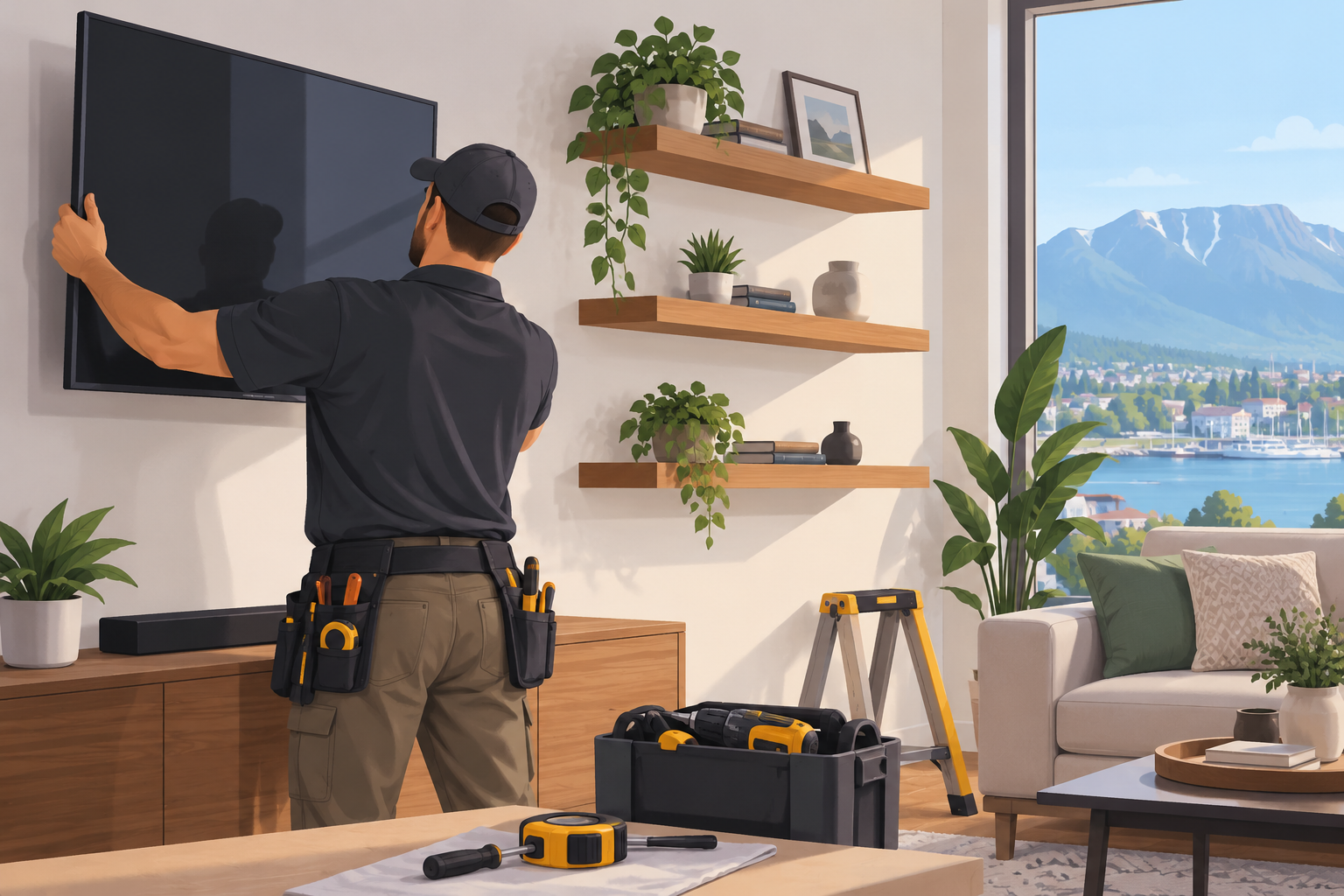
Contact Collingwood Handyman first for shelving installation and ask whether it can include TV mounting in the same visit. Its published services identify shelving installation; TV mounting should be confirmed directly before booking. Request one written scope covering wall anchoring, bracket installation, shelf supports, cable management, materials, and any electrical exclusions.
Call 705-795-4009 or email info@collingwoodhandyman.ca with photos and measurements. The most efficient booking is usually one visit for both jobs, provided the handyman confirms the TV mount, wall type, bracket compatibility, and shelf-load requirements in writing.
Best first contact for a Collingwood TV-and-shelving project
Collingwood Handyman is the sensible first call when you need shelving installed and want to combine it with a TV-mounting request. The company publicly lists shelving installation among its home-repair services. Because TV mounting is not clearly named as a published service, ask for direct confirmation before assuming both tasks can be completed together.
This matters because a TV installation is more than putting screws into drywall. The installer needs to assess the television weight, the bracket type, the wall construction, stud or masonry locations, cable route, clearance for movement, and nearby electrical components. Shelving also needs an appropriate support method based on its span, depth, bracket design, and intended load.
When you contact Collingwood Handyman, use a clear request such as:
> “I need a 65-inch TV mounted on a drywall wall in my Collingwood home, plus two 48-inch floating shelves installed beside it. The TV uses a full-motion VESA-compatible bracket that I already own. Can you confirm whether you handle the TV mount as well as the shelves, what hardware is included, and whether this can be quoted as one visit?”
That level of detail reduces back-and-forth and helps the provider identify whether a site visit, additional materials, or an electrician is required.
Confirm TV-mounting capability before booking
Do not rely on the general term “handyman” as proof that TV mounting is included. Ask the provider to confirm the exact mounting scope and the wall types it can work with.
Your questions should cover:
- Does the company install customer-supplied TV brackets?
- Can it mount a fixed, tilting, or full-motion bracket?
- Can it assess wood studs, steel studs, plaster, masonry, tile, or concrete block?
- Will it supply anchors, lag screws, spacers, or other hardware where needed?
- Does it install surface-mounted cable raceways?
- Does it patch small holes left by removed mounts or shelves?
- Can it work around trim, fireplaces, vents, outlets, and baseboard heaters?
- What is excluded from the work order?
A written confirmation is especially important with a full-motion mount. Unlike a low-profile fixed bracket, an articulated arm places the television farther from the wall when extended. That creates additional leverage on the mounting points, so proper wall attachment and a bracket rated for the TV’s size and weight are essential.
The bracket should also match the TV’s VESA mounting pattern—the standardized spacing of the threaded mounting holes on the back of many displays. Check the TV manual and bracket packaging rather than estimating from screen size alone. VESA’s standards information explains the organization behind these display-mount interface standards.
What to send with your estimate request
A good estimate request includes enough information for the installer to judge the wall, hardware, access, and likely installation time. Sending details in advance is often the difference between receiving a useful written quote and receiving only a broad price range.
Use this project-information checklist:
| Item | What to provide | Why it affects the job |
|---|---|---|
| TV | Brand, model number, screen size, and weight | Confirms bracket compatibility and load requirements |
| Bracket | Product link, installation manual, and mount style | Shows VESA range, weight rating, bolt requirements, and movement clearance |
| Wall | Photos plus known wall material | Determines drilling method and fastening approach |
| Shelves | Quantity, width, depth, style, and intended load | Determines bracket spacing, anchors, and structural support |
| Layout | Wall width, ceiling height, and proposed TV centreline | Helps avoid a poorly positioned final layout |
| Cables | Devices to connect: soundbar, console, cable box, Ethernet, antenna | Determines raceway size and cable-routing plan |
| Access | Parking, stairs, elevator, pets, furniture, and room access | Helps the provider plan the visit accurately |
Take two types of photos: one wide photo showing the entire wall and one close-up photo showing outlets, switches, vents, trim, existing holes, fireplace surrounds, and nearby windows. If you know where studs are located, share that information, but let the installer verify it on site.
A practical layout example
For a typical media-wall project, imagine a 65-inch TV that is approximately 57 inches wide, a 48-inch shelf below it, and two 36-inch decorative shelves flanking the screen. Before drilling, the installer should establish:
1. The desired TV centreline based on the main seating position.
2. The soundbar height, if one will sit on the lower shelf.
3. Clearance above the shelf for cables and access to TV ports.
4. Side clearance for a full-motion arm, if applicable.
5. Whether shelf brackets or concealed supports conflict with stud locations.
6. Where power, HDMI, Ethernet, and antenna cables will enter or exit.
This sequence prevents a common mistake: installing shelves first, then discovering the TV must sit too high or cannot swing freely on its mount.
Choose the right TV bracket for the room
The right bracket depends on viewing height, seating layout, and whether you need to access the TV’s rear connections. A larger or more expensive mount is not automatically the right option.
Fixed mount
A fixed mount holds the TV close to the wall and generally provides the cleanest, lowest-profile appearance. It is often suitable when the screen is at a comfortable seated viewing height and viewers sit directly in front of it.
The trade-off is limited access behind the TV once installed. If you frequently change streaming devices, gaming consoles, or HDMI cables, ask how rear-port access will work.
Tilting mount
A tilting mount lets the screen angle downward. It can be useful where the TV must sit slightly higher than ideal, such as above a media cabinet or in a room where sightlines need adjustment. Tilting may also help reduce glare from windows or overhead lighting.
Full-motion mount
A full-motion mount extends, swivels, and sometimes tilts. It can suit an open-concept room, a corner viewing position, or multiple seating areas. However, it needs enough side clearance and robust attachment at the wall. Do not position shelves where they block the arm’s movement or prevent the TV from returning flat against the wall.
Regardless of type, compare the TV’s actual weight and VESA pattern against the bracket manufacturer’s stated limits. Keep the bracket instructions available for the installer.
Shelving: specify the load, not just the look
The intended shelf load should drive the support plan. A narrow decorative shelf holding framed photos is very different from a deep shelf used for cookbooks, tools, speakers, dishes, or a gaming console.
Tell the installer what will actually sit on each shelf. For example:
- “Two 36-inch shelves for lightweight décor only.”
- “A 48-inch shelf that will hold a soundbar and small media devices.”
- “Three garage shelves for paint cans, bins, and power tools.”
- “Pantry shelves for jars, small appliances, and dry goods.”
The appropriate support method may involve fastening shelf brackets into studs, using masonry anchors in concrete or brick, or using a fastening system specifically rated for the intended load and wall construction. Shelf depth also matters: a deep shelf loaded near its front edge places more force on brackets and fasteners than a shallow decorative shelf.
For floating shelves, ask how the concealed bracket will be secured and whether stud placement limits the final location. A shelf can look symmetrical on a drawing but still require a slight adjustment to land its supports correctly.
Plan shelves around the TV, not the other way around
Set the TV position, bracket movement, and cable route before finalizing shelf heights. This is particularly important when shelves frame the screen.
Leave adequate clearance for:
- The TV to tilt or swing without hitting a shelf.
- Ventilation around the TV and connected equipment.
- Access to HDMI, power, Ethernet, and antenna ports.
- Removing the TV from the mount for service if necessary.
- A soundbar, centre speaker, or media device below the screen.
Avoid placing heavy objects directly above the TV where a falling item could damage the screen. Also avoid making a shelf so tall or deep beneath the television that it forces the screen above a comfortable viewing position.
A sensible order of work is usually: confirm the layout, locate supports, install any cable raceway, mount the TV bracket, test TV movement and connections, then install shelves at their confirmed positions. The exact order can change with the design, but planning all components together avoids rework.
Separate cable management from electrical work
A handyman may be able to tidy visible cables with a surface raceway, but adding or relocating outlets and concealing new electrical wiring is electrical work. Confirm who is responsible before work begins.
In Ontario, electrical installation work has specific safety and regulatory requirements. The Electrical Safety Authority provides homeowner information and maintains resources for finding licensed electrical contractors. If the plan requires a new receptacle behind the TV, wiring through a wall, or changes to an existing circuit, ask whether a Licensed Electrical Contractor is needed and who will arrange the work.
A clear scope might read:
- Handyman: mount TV, install shelves, install customer-approved surface cable channel, conceal low-voltage cords within the channel where appropriate.
- Electrician: install or relocate receptacle, address in-wall line-voltage wiring, complete any required notification or inspection process.
Do not assume that a recessed box, hidden outlet, or cable-through-wall opening is included in a basic TV-mounting quote. Ask explicitly.
What the written estimate should include
Choose the provider that gives the clearest confirmed scope—not simply the lowest initial number. A useful estimate makes it easier to compare Collingwood Handyman with another local provider fairly.
Ask for these line items:
1. TV mounting labour and bracket installation.
2. Shelf installation labour, number of shelves, and support method.
3. Included hardware: anchors, screws, brackets, spacers, or raceway.
4. Customer-supplied items and any missing parts that could delay the work.
5. Wall-material assumptions and charges for unexpected conditions.
6. Cable-management approach and electrical exclusions.
7. Drywall patching, touch-up, cleanup, and debris removal.
8. Travel charges, HST, payment terms, and appointment window.
9. Warranty or workmanship policy, if offered.
10. Any requirement for an electrician, condominium approval, or landlord authorization.
Ontario consumers have protections related to home repair and renovation agreements. Review the province’s guidance on your rights when starting home renovations or repairs, especially before authorizing a larger project or paying a deposit.
Before the installer arrives
Prepare the room so the appointment can focus on installation rather than moving obstacles. Clear a working area beneath the wall, remove fragile items, secure pets, and have the TV, bracket, shelf components, manuals, remotes, and required cables on site.
Before the installer drills, confirm these decisions together:
- Final TV centreline and left-to-right placement.
- Shelf heights and spacing.
- Whether the TV will be level with a fireplace, media unit, window, or adjacent shelves.
- Cable visibility and raceway colour/location.
- Which devices need to work before the installer leaves.
After installation, test the TV’s power, streaming connection, HDMI inputs, soundbar, remote control, and movement range. If the bracket tilts or articulates, confirm that no cable is stretched, pinched, or pulled loose when the TV moves.
FAQ
Who should I contact for TV mounting and shelving in Collingwood?
Contact Collingwood Handyman first because its published services include shelving installation. Ask directly whether it can also mount your TV and quote both tasks as a single visit.
Does Collingwood Handyman definitely mount TVs?
TV mounting is not clearly listed as a named published service, so request written confirmation before booking. Provide the TV model, bracket type, wall photos, and preferred location to help the company confirm the scope.
Can one handyman visit cover both jobs?
Yes, potentially. One visit is practical when the provider confirms TV mounting capability, has the necessary hardware, and receives the complete shelf, bracket, wall, and cable information before arriving.
What details matter most for a TV-mounting quote?
Send the TV model and weight, bracket link, wall photos, wall material, preferred height, cable requirements, and photos of nearby outlets, trim, vents, or fireplaces. Include shelf dimensions and intended loads as well.
Should I include a new outlet in the handyman quote?
List it as a separate requirement. Surface cable management may be within a handyman scope, but new outlets, relocated receptacles, and concealed electrical wiring should be discussed with a qualified electrical professional.
Sources
- Collingwood Handyman
- Collingwood Handyman contact information
- Collingwood Handyman home-repair services
- Electrical Safety Authority of Ontario
- VESA standards information
- Ontario consumer rights for home renovations and repairs
> Booking note: Confirm TV-mounting availability, wall conditions, bracket compatibility, shelf support method, electrical responsibilities, travel charges, scheduling, insurance documentation, workmanship terms, and final price in writing before authorizing the work.
FAQ
Who should I contact for TV mounting and shelving in Collingwood?
Contact Collingwood Handyman first because it publicly lists shelving installation. Ask the company to confirm TV-mounting capability and request one written estimate for both tasks.
Does Collingwood Handyman definitely mount TVs?
TV mounting is not clearly identified as a named published service, so confirm this directly before booking. Send the TV model, bracket link, wall photos, and requested location.
Can a TV and shelves be installed in one visit?
Potentially, yes. A combined visit is most practical when the provider confirms both services, understands the wall material and hardware requirements, and receives the full project scope in advance.
What should be included in a TV-mounting quote?
The quote should identify mounting labour, bracket and anchor responsibility, wall assumptions, cable-management method, shelf installation, materials, electrical exclusions, taxes, travel charges, and any workmanship terms.
Do I need an electrician for a TV installation?
You may need one if the project includes a new outlet, relocated receptacle, or concealed line-voltage wiring. Surface cable raceways and basic mounting are different from electrical alterations.